Primal Philosophy by Lucas Fain
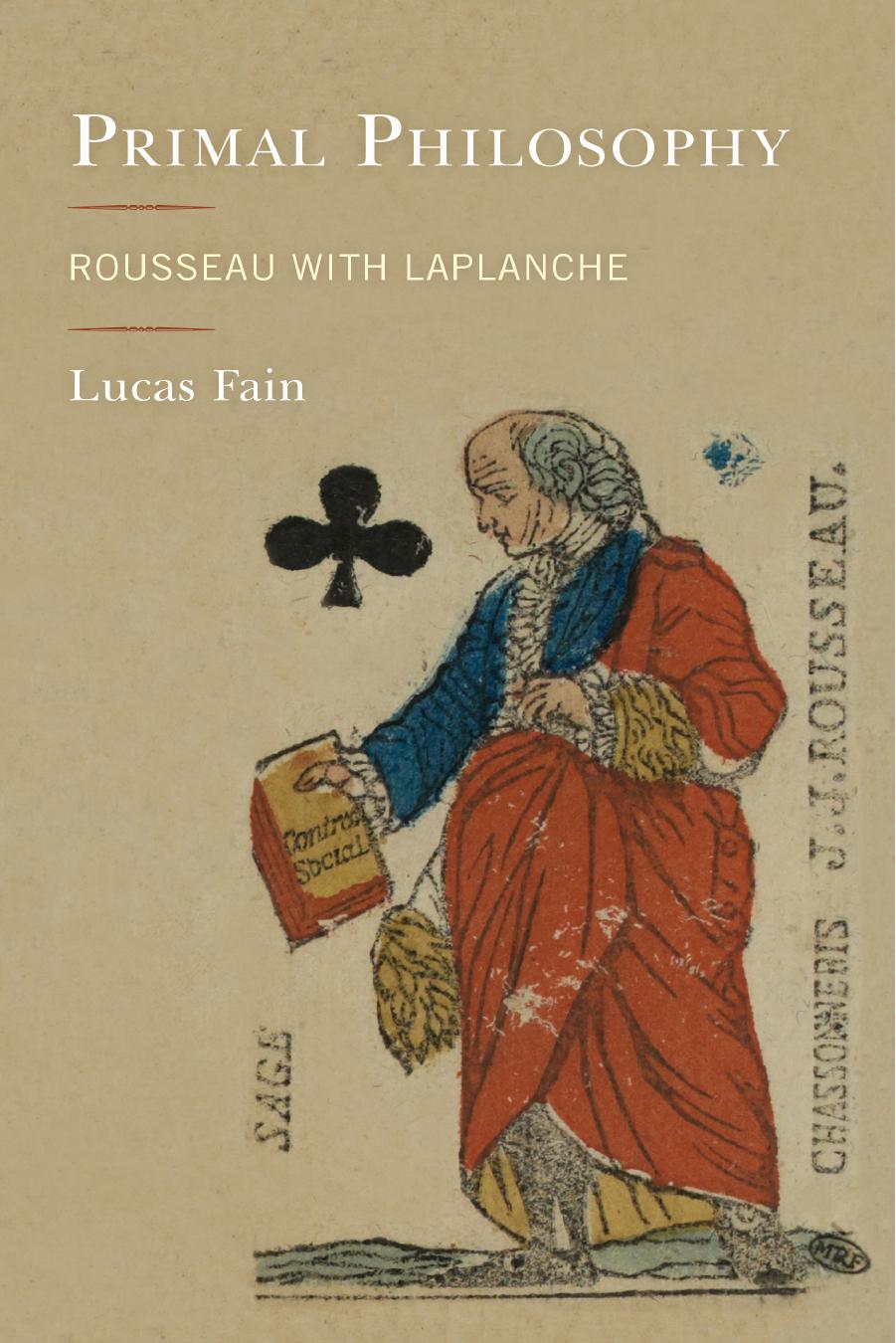
Author:Lucas Fain
Language: eng
Format: epub, pdf
ISBN: 9781538146194
Publisher: Rowman & Littlefield Publishers
Chapter 4
Primal Philosophy
I. Going Farther
It is a guiding thesis of this book that Rousseauâs critique of the tradition of first philosophy from Aristotle to Descartes has continuing relevance for contemporary concerns about the fate of philosophy after Heidegger. It is a corollary of this thesis that Rousseau perceived the need to rethink the foundations of philosophy, not for the sake of fashion or invention, but because the degeneration of philosophy under the aegis of Enlightenment required a return to the âoriginâ and âfoundationsâ of philosophy itself. This motion of return applies in a double sense. It first concerns Rousseauâs defense of Socrates against the usurpation of Socratic practice by the modern esprit de système. Second, because this motion involves a return to the idea of Socratic practice, it must presuppose the possibility of philosophy as a distinct form of human experience or endeavorâone rooted in the genesis of philosophic wonder. We consequently face the following situation. If the genesis of philosophic wonder takes root in a process of seduction, then we require a theory of seduction to account for the possibility of philosophy. Yet Rousseau does not provide a formal theory of seduction, in which case it is tempting to recall his reply in the âPreface of a Second Letter to Bordesâ that âfor want of perceiving the trunkâ he showed âonly the branchesâ and âthat was enough for those capable of understanding.â1 If this response is sufficient, it is not satisfactoryâespecially if we want to grasp the unspoken root of Rousseauâs legacy-as-task: the need to account for the possibility of philosophy and its significance for the discourse of first philosophy after Aristotle. In the spirit of âgoing farther along the same road,â we now require an account of the process of seduction that explains not only the derivation of amour-propre from amour de soi, but also the genesis of philosophic wonder. To that end, I turn to the psychoanalytic theory of seduction first elaborated by Freud and more recently developed by the late Jean Laplanche (1924â2012).
It should be emphasized that this appeal to psychoanalytic insight comes as neither a decision for an arbitrary hermeneutic method, nor does it require us to refashion Rousseauâs thought according to an external paradigm. It is rather my contention that Rousseauâs mature thought contains within itself a nascent doctrine of seduction; and as a consequence, Rousseauâs account of the genesis of philosophic wonder can be rendered visible, without distortion, by the deep compatibility it shares with the psychoanalytic doctrine. Broadly speaking, this compatibility consists in the emphasis we find on the desire of the other, understood as the source of enigmatic messages that possess the power of seduction for the same reason they escape translation. Precisely because these messages escape translation, they demand translation. As we have already seen, albeit in a preliminary way, this was the exact case in Rousseauâs account of the causes étrangeres, the âforeign causesâ that engender amour-propre by enlivening the force of public esteemâthe exigent expression of the âmoral aspect of love.
Download
This site does not store any files on its server. We only index and link to content provided by other sites. Please contact the content providers to delete copyright contents if any and email us, we'll remove relevant links or contents immediately.
Spell It Out by David Crystal(36221)
Life for Me Ain't Been No Crystal Stair by Susan Sheehan(35895)
The Great Music City by Andrea Baker(33427)
Cecilia; Or, Memoirs of an Heiress — Volume 1 by Fanny Burney(32712)
Cecilia; Or, Memoirs of an Heiress — Volume 2 by Fanny Burney(32075)
Cecilia; Or, Memoirs of an Heiress — Volume 3 by Fanny Burney(32058)
Professional Troublemaker by Luvvie Ajayi Jones(29744)
The Secret History by Donna Tartt(19443)
We're Going to Need More Wine by Gabrielle Union(19162)
Twilight of the Idols With the Antichrist and Ecce Homo by Friedrich Nietzsche(18761)
All the Missing Girls by Megan Miranda(16646)
Cat's cradle by Kurt Vonnegut(15538)
For the Love of Europe by Rick Steves(14863)
Pimp by Iceberg Slim(14778)
Bombshells: Glamour Girls of a Lifetime by Sullivan Steve(14210)
Norse Mythology by Gaiman Neil(13555)
Talking to Strangers by Malcolm Gladwell(13521)
Fifty Shades Freed by E L James(13340)
The Social Justice Warrior Handbook by Lisa De Pasquale(12286)
